The Patrick O'Keeffe
Traditional Music Festival
Celebrating the music and legacy of one of Ireland's greatest traditional musicians since 1993.
Our Story
The festival came into being just as the fall of 1993 approached.
RTE Radio 1 presenter and producer Peter Browne prompted that some event or other should be held to honour O'Keeffe — as that year marked the 30th anniversary of his death. Mary Jones, who ran Charlie Horan's Bar in Castleisland at the time, took up the baton from there and the rest is the history we read today.
The 30th anniversary of O'Keeffe's death prompted Peter Browne to take a closer look at the life and times of the man who lived and died at a time when broadcasting and recording in rural areas presented great obstacles to the pioneering spirits who undertook these tasks.
There did and indeed does, however, exist a few precious recordings made by the likes of Seamus Ennis and later by Ciarán Mac Mathúna. And, for Peter Browne, the timing of the festival could hardly have been a minute too soon.
The first session of the inaugural Patrick O'Keeffe Traditional Music Festival took place at The Rambling House on Friday evening, October 22, 1993. More than three decades later, the festival continues to draw musicians and music-lovers from across Ireland and around the world to Castleisland every October.
Festival dates 2025
Thursday 23 – Monday 27 October 2025
Castleisland, Co. Kerry, Ireland
The Man
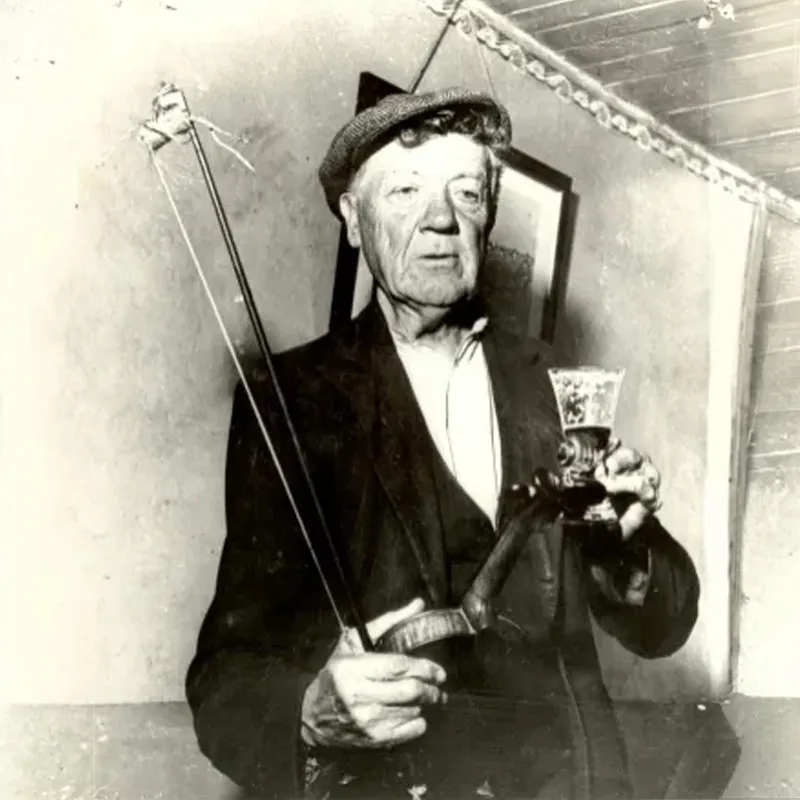
Patrick O'Keeffe(1881–1963)
Patrick O'Keeffe was one of the most celebrated traditional fiddle players Ireland has ever produced. Born in 1881 in Gleanntán, Cordal, near Castleisland, County Kerry, he spent his entire life immersed in the music of the Sliabh Luachra region — a tradition characterised by its driving polkas, lilting slides, and a rhythmic energy unlike anything found elsewhere in Ireland.
Though O'Keeffe lived and worked far from the cultural centres of Dublin or Cork, his influence on Irish traditional music was profound. For decades he taught music to young players throughout north Kerry and east Cork, passing on the Sliabh Luachra style with a generosity and depth of knowledge that shaped generations of musicians. He was, above all, a teacher as much as a performer — a custodian of a living tradition.
Recognition came through the work of Ireland's great sound collectors. Séamus Ennis recorded O'Keeffe in the early 1950s, capturing performances that would otherwise have been lost to time. Ciarán Mac Mathúna, too, recognised his genius and preserved his playing for posterity. These recordings remain among the most treasured documents in the archive of Irish traditional music.
O'Keeffe was also a noted singer, a storyteller, and a man of considerable wit and intelligence. He was a central figure in the musical and social life of Castleisland and its surroundings for much of the twentieth century. He died in Castleisland in 1963, having given a lifetime to the music he loved — a music that continues to bear his name and his influence to this day.
The Music
Sliabh Luachra
Sliabh Luachra — the "rushy mountain" in Irish — is one of the most distinctive and celebrated musical regions in all of Ireland. It straddles the mountainous border country of Kerry, Cork, and Limerick in the southwest, centred around the towns and villages of Castleisland, Scartaglin, Ballydesmond, Newmarket, Gneeveguilla, and Knocknagree.
The music of Sliabh Luachra is set apart by its rhythmic vitality and its repertoire. Where much of Ireland favours jigs and reels, Sliabh Luachra is the home of the polka and the slide — two dance forms that carry a breathless, irresistible momentum. The ornamentation is spare and sharp; the rhythm is everything. It is music made to be danced to, and the tradition of céilí dancing and set dancing has always been central to the life of the region.
The lineage of great Sliabh Luachra musicians is extraordinary. Alongside Patrick O'Keeffe stand names such as Pádraig O'Keeffe — the master teacher of Gleanntán — Denis Murphy, Julia Clifford, Johnny O'Leary, and Jackie Daly. Each brought their own voice to the tradition while remaining rooted in the sound and spirit of the region. Their recordings, their teaching, and the music itself continue to inspire players around the world.
The Patrick O'Keeffe Festival is held in the very heartland of this tradition, and its session trail winds through the pubs and halls of Castleisland and the surrounding villages — the same venues where O'Keeffe and his contemporaries played. That continuity is at the heart of what makes the festival special.
The Town
Castleisland, Co. Kerry
Castleisland — Oileán Ciarraí in Irish, meaning "Island of Kerry" — is a lively market town nestled in the valley of the River Maine, about 19 kilometres east of Tralee. Surrounded by rolling green hills and within easy reach of Kerry's wild Atlantic coastline and mountain ranges, it is one of the county's most welcoming and well-connected towns.
The town's history reaches back to the Anglo-Norman period, when a castle was built here in the thirteenth century. The "island" in its name refers to the raised ground amid the river's floodplain on which the original settlement stood — a feature that shaped the town's layout and gave it its enduring name. Castleisland grew as a market town over the centuries, and that spirit of commerce and community remains alive today in its busy main street and strong local culture.
For visitors to the Patrick O'Keeffe Festival, Castleisland is the ideal base. The town offers a warm welcome to all who come — in its hotels, B&Bs, pubs, and restaurants. Every October, it transforms into the beating heart of traditional Irish music, as players and listeners fill the streets and session venues from Thursday to Monday. The atmosphere is unlike anything else in the Irish festival calendar.
Castleisland also sits at the gateway to the Sliabh Luachra region — the broader mountain landscape that produced the music at the heart of the festival. The surrounding countryside, with its ancient ringforts, holy wells, and mountain passes, gives a sense of the deep roots from which this tradition grows. A visit to the festival is as much a journey into place as it is into music.